JournalModern, editable websites
European Accessibility Act: what your website has to do
Since 28 June 2025, many websites selling to consumers in the EU must be accessible. Who it applies to, what it requires in practice and how this site meets it.
Since 28 June 2025, the European Accessibility Act requires many websites and apps that sell products or services to consumers in the EU to be accessible: usable with a screen reader and a keyboard, with good contrast and captioned videos. It mainly affects e-commerce (online bookings included), banking and passenger transport; micro-enterprises providing services are exempt. In Spain it’s Law 11/2023. This is a practical summary, not legal advice.
Contrast checker
Contrast ratio2,4 : 1
- Normal text · AA
- Large text · AA
- Normal text · AAA
- Large text · AAA
Does the law apply to me?
A rough guide, not legal advice. For your specific case, ask a lawyer.
Who it applies to
- E-commerce. Any website or app selling products or services to consumers: online shops, hotel or activity bookings, tickets.
- Other specific services. Banking, passenger transport, e-books and electronic communications, each with its own requirements.
- Not micro-enterprises providing services. Fewer than 10 people and an annual turnover or balance sheet of €2 million or less. Even so, an accessible site reaches more people.
- The public sector already had its rules. Under the EU Web Accessibility Directive (2016/2102), public bodies’ websites and apps must be accessible; Spain applies it through Royal Decree 1112/2018.
There are transition periods until 2030 for some cases and exemptions where adapting something would be a disproportionate burden, but don’t count on them without asking a lawyer.
What it requires in practice
The technical reference is the European standard EN 301 549, which for websites relies on WCAG 2.1 at level AA. In terms of what you see:
- Enough contrast. Normal text needs a ratio of at least 4.5 to 1 against its background; large text, 3 to 1.
- Everything works with a keyboard. Menus, forms, galleries and dialogs can be used without a mouse, and focus is always visible.
- Alternative text. Images that carry information have a description for people who can’t see them.
- Video and motion. Videos with speech have captions, and anything that moves by itself for more than five seconds can be paused.
- Clear forms. Every field labelled, and errors that explain how to fix them.
- Structure. Ordered headings, the page language declared and links that say where they go.
- Accessibility information. The law asks you to explain how your service meets the requirements, for example in your terms and conditions or on a page of its own.
How this website meets it
This site scores 100 for accessibility in Lighthouse on the home page, the journal and the case studies (measured on 27 October 2026). Behind that number: the colours in both themes, light and dark, have the contrast the guidelines ask for; the whole site works with a keyboard and focus is always visible; there’s a link to skip straight to the content; the editor won’t publish an image without its description; the journal’s graphics work with a keyboard and announce their results to screen readers; and people with reduced motion turned on see the site without animation.
Even so, an automated tool only catches part of the problems. What really counts is testing the site with a keyboard and a screen reader.
Why it’s worth it even if you’re not obliged
An accessible website works better for everyone: people reading on a phone in bright sun, people with one hand busy, people on a slow connection. And many of the same things, such as alternative text, ordered headings and good structure, help Google understand the page.
If your site belongs to a festival or a public institution, I also cover it in Film festival website design.
In short
If you sell to consumers online in the EU and you’re not a micro-enterprise, the European Accessibility Act has required an accessible website since June 2025: good contrast, keyboard use, alternative text, captioned videos, clear forms and accessibility information. It’s easier to get right while designing than to fix afterwards.
If you’d like to know where yours stands, tell me about your site and we’ll review it together.
Keep reading
- How to change your website without losing your Google rankingsWhat to do before, during and after launching a new website so Google doesn’t forget you, with my own site’s change of domain as the example.
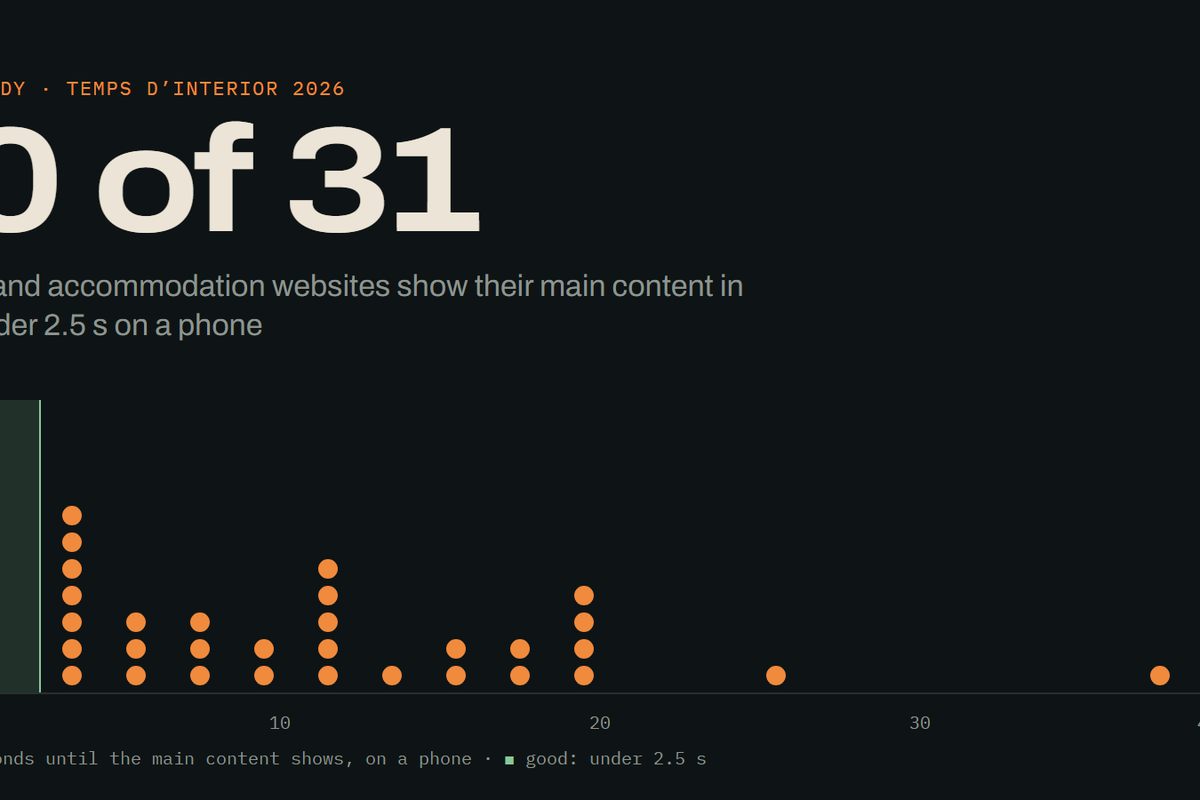
- I reviewed 31 rural accommodation websites: what keeps coming upI put the websites of the places to stay in the Temps d’Interior 2026 guide through the same tests. None loads in time on a phone, nearly always for the same reason.
- Why Elementor slows down your website (and what to do)I measured two of my own sites, one built with Elementor and one by hand: what slows an Elementor site down and what you can do about it today.