JournalHotel & travel websites
I reviewed 31 rural accommodation websites: what keeps coming up
I put the websites of the places to stay in the Temps d’Interior 2026 guide through the same tests. None loads in time on a phone, nearly always for the same reason.
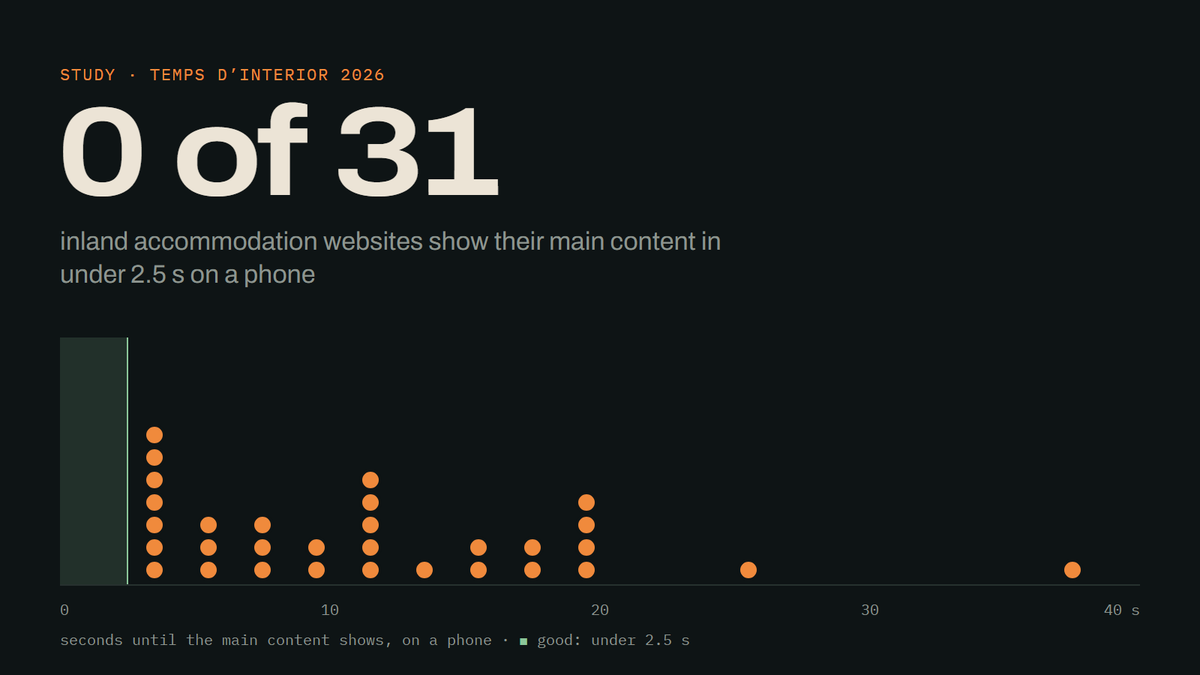
On 24 November I put the websites of the 34 places to stay in Turisme Comunitat Valenciana’s Temps d’Interior 2026 guide through the same tests: hotels, rural hotels and houses let whole, across Alicante, Castellón and València. I could analyse 31. The full figures, with charts and how I measured them, are in the study. Here I go through what keeps coming up and where I’d start.
Four figures
The study in four figures · 31 websites
10.5 s
is how long the median website takes to show its main content on a phone
Google’s target: 2.5 s · 0 of 31 meet it
23 of 31
can be booked on their own website, with dates and price
11 of 31
have no English version of their own
7 of 31
tell Google, with structured data, that they’re a place to stay
Photos outweigh everything else
The median home page weighs 3.6 MB, and nearly two thirds of it is photos. On 18 of the 31 websites the photos are larger than a phone screen needs, and on 13 a single photo weighs more than 500 KB. The servers, on the other hand, answer in under half a second: the trouble comes afterwards, when the phone has to download all of that.
The same photo, two weights
The study’s median home page: 3.6 MB
Photos: 64%. Everything else: 36%.
Over the connection Google’s phone test simulates (1.6 Mbps). On a phone screen both look the same; one arrives 15 times sooner.
It makes sense: an inland place to stay sells the landscape and the house, and the photos are the best it has. But a 200 KB hero photo in WebP looks just as good on a phone as a 3 MB one. I go into it in why a slow website costs you bookings.
Nearly all sell direct; whole houses less so
Three in four have a booking engine, and between them they use a dozen different engines. Where it’s missing most is in houses let whole: 5 of 9 can be booked online, against 18 of 22 places let by the room. On the rest you have to ask for availability by form, email or WhatsApp, and every extra step is a chance to go back to the platform. To put a figure on it, the commission calculator tells you how much Booking.com takes a year.
How a guest books on these websites
Own booking engine
- Your site
- Dates
- Price
- Pays
- Booked
There and then, without leaving your website.
Ask for availability only
- Your site
- Form
- Wait
- Reply
- Pays
It depends on when you reply; meanwhile the guest keeps looking elsewhere.
Sends to Booking.com
- Your site
- Booking.com
- Pays there
- Commission
Booked there and then, but on the platform and with its commission.
Can be booked on their website
Let by the room18 of 22
Houses let whole5 of 9
English, and what Google reads
Of the 11 websites without English of their own, 4 use an automatic translator in the browser. For the guest it’s better than nothing, but search engines don’t see that text, so the website doesn’t come up when someone searches in English.
Language map
What the visitor sees
What Google finds
Pages it can show in its results
Each language has its own address and all three point to each other. Google shows the French version to people searching in French.
Only the Spanish page exists. The translation happens in the visitor’s browser, so Google never sees it: in France you don’t show up for searches in French.
And only 7 of 31 have structured data: a few invisible lines that tell Google, and more and more often assistants like ChatGPT, that this is a hotel or a holiday house, where it is and what it costs.
What Google reads
In the page’s code
<!-- nothing: just the text and photos --><script type="application/ld+json">
{
"@context": "https://schema.org",
"@type": "Hotel",
"name": "Casa del Olivo",
"address": "Calle Mayor 3, your village",
"priceRange": "€95–140",
"telephone": "+34 600 000 000"
}
</script>
What it understands Example
A page with text and photos. Is it a hotel, a restaurant, a blog? Where is it? What does it cost? It has to guess by reading.
- What it isA hotel
- NameCasa del Olivo
- WhereCalle Mayor 3, your village
- Price€95–140 a night
- Phone+34 600 000 000
One more detail: 7 websites stop visitors from zooming in with two fingers, which accessibility guidelines (WCAG) ask websites not to block. If you want to know who the law applies to, I explain it in the European Accessibility Act.
Where I’d start
How many does your website have?
If you run one of these places and want your results, ask me and I’ll send them: no name appears in the study. And if yours isn’t in the guide, I can put your website through the same tests with the free review.
Keep reading
- Website background video: how to use it without slowing the site downA hero video can weigh more than the rest of the site. How I prepare it to stay light, load fast and not get in the way, with real numbers from a shot of mine.
- Direct bookings: how your hotel website can depend less on OTAsEvery Booking.com or Expedia reservation costs 15 to 20% in commission. What your website needs so more guests book directly with you.
- Boutique hotel website design: the complete guideWhat a boutique hotel website needs so guests book direct: the opening, photos, booking, rooms, languages and speed, part by part.